

I go to Pearson High School in Gqeberha every year to have serious and difficult conversations with the 1000+ learners who are fortunate enough to be at this astonishing school. Pearson does not shy away from hard conversations and understands that one can’t talk about social media just once as a box ticking exercise and then high five each other for being amazing educators and parents. Like all the other tough teenage convos (sex, porn, gaming, bullying) repetition is key. Sometimes the penny drops the 5th time you have the same interaction. (Or not.)
But this time round I felt altogether less confident about what I was going to say and how I planned to pitch things to the teens… because you see I have been focusing every year on responsible use and engagement in the virtual world. And in 2026 a whole bunch of things have happened which have made me doubt, enormously, if that is even possible. It’s a bit like encouraging the responsible use of heroin or cocaine to young folk. Or any folk. (Stay with me, I am not being a drama queen.)
Pete, Hannah and I were out for dinner somewhere and I was distracted by another family of three at a table nearby. The couple were in their early 30’s and were both on their smartphones throughout the meal. They had a 15-month-old child in a pram with a nifty little arm-like cell phone holder attached to his funky pram so he could scroll comfortably. No interaction, no eye contact, no conversation. I felt a deep sense of unease in my body. On our way out I said hello to them and asked them where they got the accessory for the pram. Without looking up from his screen dad responded: Oh, the pram comes with it included I think its standard now.
OMG. Really? I don’t know if this is true, but my heart sank. How does this child learn to engage if his parents don’t talk to him or make eye contact?
Then a mate of mine who is now a professor at a university was telling me that although his students are brighter than ever, they seem to have the attention span of a goldfish and are simply unable to get through the volume of reading that is critical for success in their chosen degree. He is adamant that their brains have atrophied from getting all their input in tiny bite sized (or reel sized) titbits. (Imagine Ox and Bongi working out with only sweet little 1kg dumbbells – what would become of those biceps and quads?)
And then I watched Adolescence on Netflix (with a steadying whisky) because I had been delaying this harrowing experience which allows one a deeply disturbing glimpse into the subcultures that our tweens and teens inhabit.
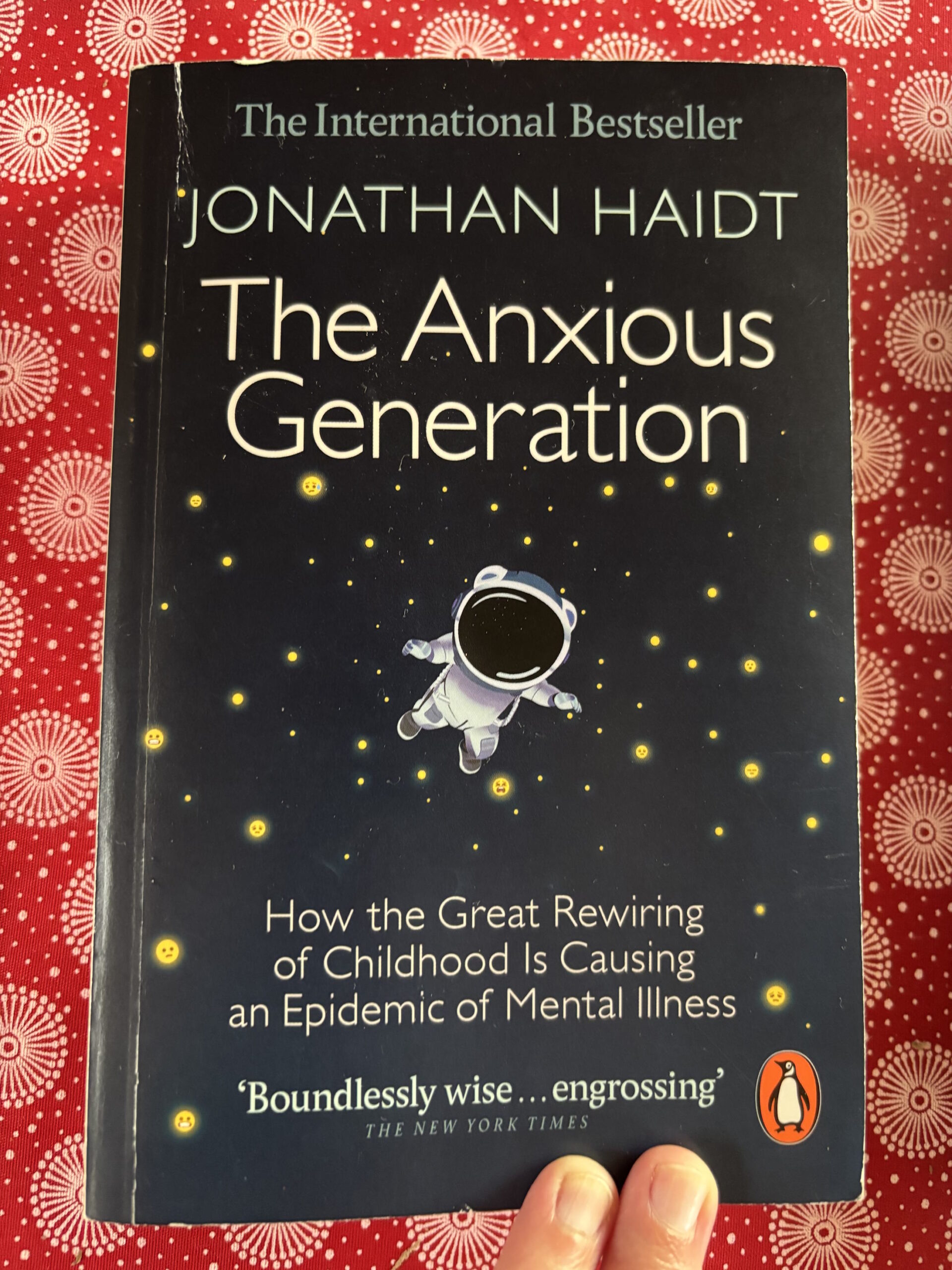
Next, (as if all this wasn’t bad enough), I read The Anxious Generation by Jonathan Heidt which is really a comprehensive report on the mental health of Gen Z: the first generation to grow up with high speed internet, 24/7 access to smartphones, not remembering a time before Insta, Snap and TikTok, ignorant of a world in which the functionality to take a selfie didn’t exist, having spent their whole life judging and being judged by the like, share and comment capacity of their preferred platforms. They have compared themselves negatively to impossible beauty and fashion standards, they have been presented with games that simulate real life risk and adrenaline so compellingly that there is no need to leave their room to take actual real life risks. (They don’t even have to take the risk of inviting someone on a date because they can get all the action they want from 24/7 access to the hardcore porn in their pocket.)
What have we done? None of this is their fault. We have basically allowed Gen Z (and are currently allowing Gen Alpha too) to be the lab rats in an uncontrolled experiment that has not ended well. The book is full of graphs and data and references to full length psychological studies and it is crystal clear that the results of this experiment are dire. Mental health does not look good. There is a 134% increase in anxiety in college students since 2010. 106% increase in depression. 72% increase in ADHD. 57% increase in bipolar diagnoses. 100% increase in anorexia. 67% increase in schizophrenia. (All college students over the same period. Admittedly in the USA so I imagine we in RSA are fairing fractionally better for various reasons. Yet we all know at a gut level that this is true.)
He highlights the fact that while we have excessively over-protected our children in the real world (no one walks or rides to school, no one goes to the shops on their own because we are hysterical about their physical safety) while simultaneously releasing them into a virtual world with little to zero control and protection.
He then goes on to name what he calls the four foundational harms: social deprivation, sleep deprivation, attention fragmentation and addiction.
But all is not lost. He very clearly sets out what we can do. When we know better, we should do better. He strongly advocates for no smartphones in primary school. No access to social media before the age of 16. (The developing brains of girls are most vulnerable to the ‘rewiring’ at the ages of 12/13 and boys at the age of 14/15.) He insists that schools should be phone free between arrival and departure. He encourages significantly more unsupervised play and vibing and age-appropriate real-life independence and risk taking.
I don’t mean to simplify what is complicated but we are not helpless. We have the power to influence these things. We changed the way we engage with cigarettes when we understood that they made us sick. We introduced seat belts and car seats when we knew they saved lives. We have rules around selling alcohol to children. If I knew what I know now a decade ago I would have managed things very differently with my own child (who was mercifully very protected though not unscathed by her parents’ affinity for places without signal, her adventure based school and backwater community.)
And so, I had to say all that in a way that would not cause the teens to switch off and shut down – and then tell them how to use their devices responsibly in the newly disciplined way this information demands. Eish. If it makes a difference to 1% of them it’s worth it. When we know better, we must do better. Please read this book.
(Note – Like alcohol, cigarettes, gambling and all our other bad habits, endless scrolling through social media, gaming and screens in general are obviously super damaging to adult humans too. We don’t feel obliged to protect adults against their own poor choices – it’s on us. But the danger doesn’t pass when our brains are fully developed. I am sure our mental health is enormously affected by screentime too. I know mine is. Feeling very motivated to introduce social media fasts to my life.)